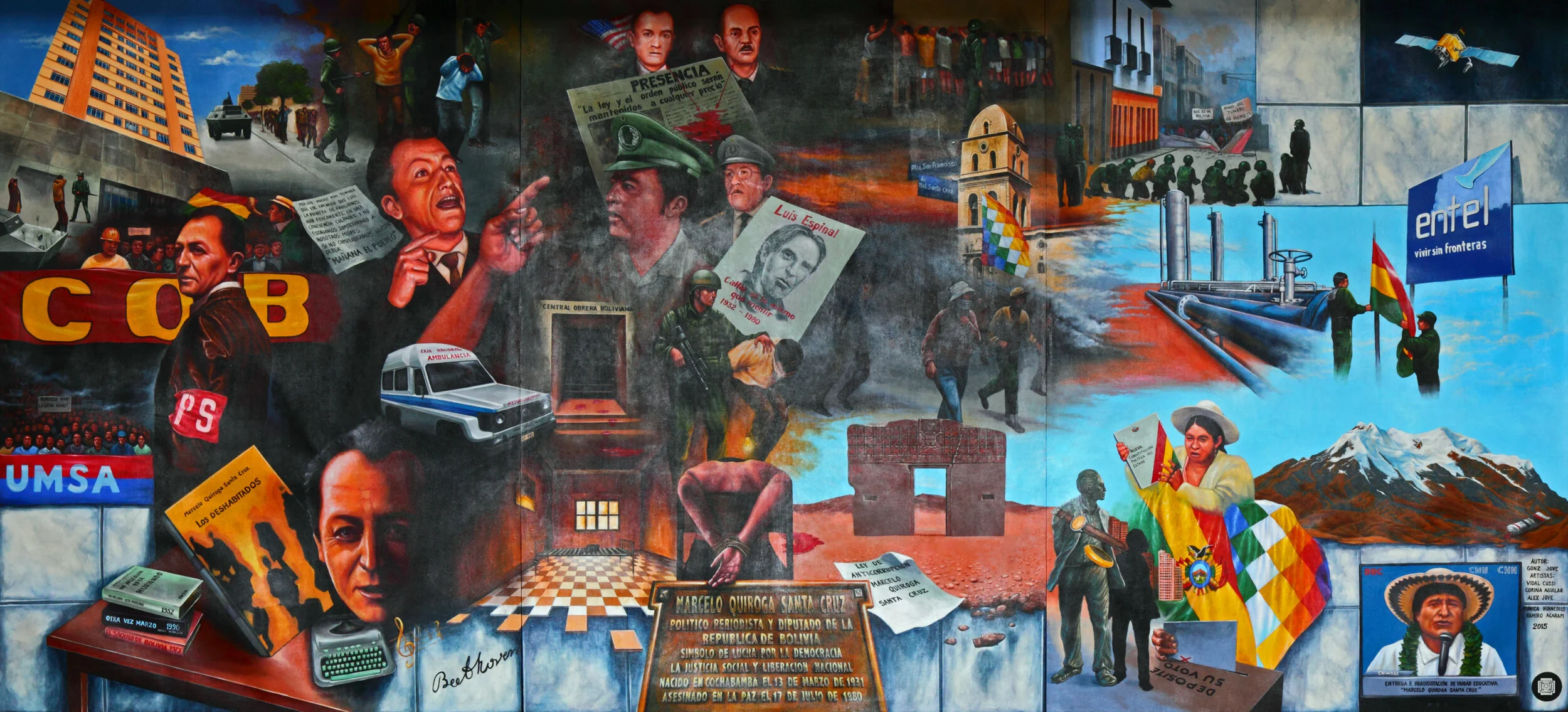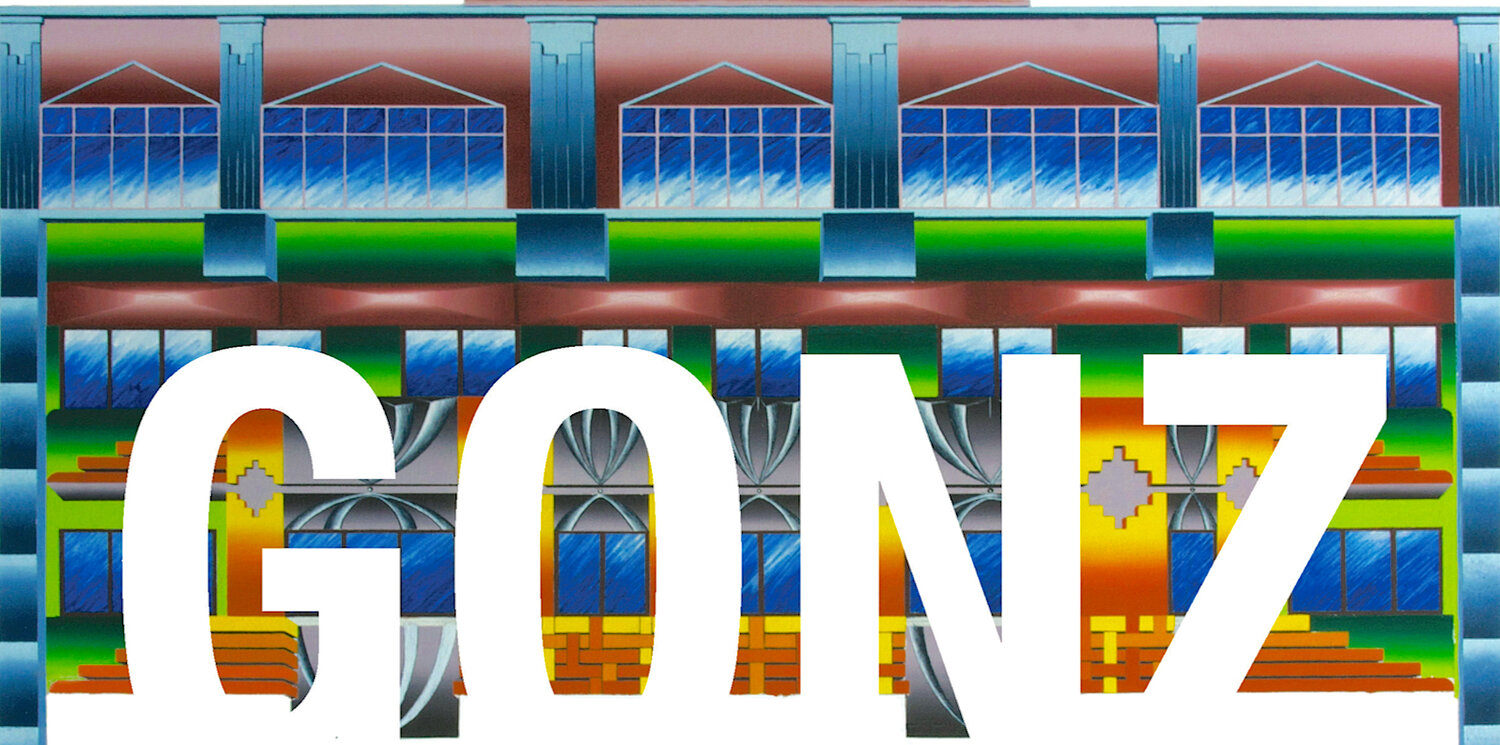
Painted on a prominent wall in La Paz, Usurpación del Boliviano is a monumental mural that spans 3 meters high by 13 meters wide. Executed in acrylic and oil directly on cement, this work is both visually striking and historically charged. As one Bolivian journalist aptly stated, “This is Bolivia’s history in five minutes.”
The mural is a sweeping visual narrative of the centuries-long exploitation and subjugation of the Bolivian people, beginning with the arrival of the Spanish conquistadors. Through layered imagery and symbolic figures, it traces the brutal legacy of colonization—from the extraction of silver from Potosí’s mines under enslaved Indigenous labor, to the continued economic and political disenfranchisement of Bolivia’s Indigenous majority.
The composition is structured as a chronological journey: it begins with the violent imposition of foreign power and religion, moves through scenes of rebellion and resistance, and ends with a critical reflection on contemporary neocolonial forces that still shape the country’s destiny.
Each section is dense with visual metaphors—chains, mountains, masks, and hands—blending historical documentation with poetic expression. The mural does not shy away from confronting injustice; rather, it forces viewers to reckon with a painful but essential truth: that Bolivia's present is still deeply entangled in the unresolved traumas of its past.
Usurpación del Boliviano is not just a mural—it is a public reckoning, a call to remember, and a tribute to the resilience of those who continue to resist exploitation in all its forms.
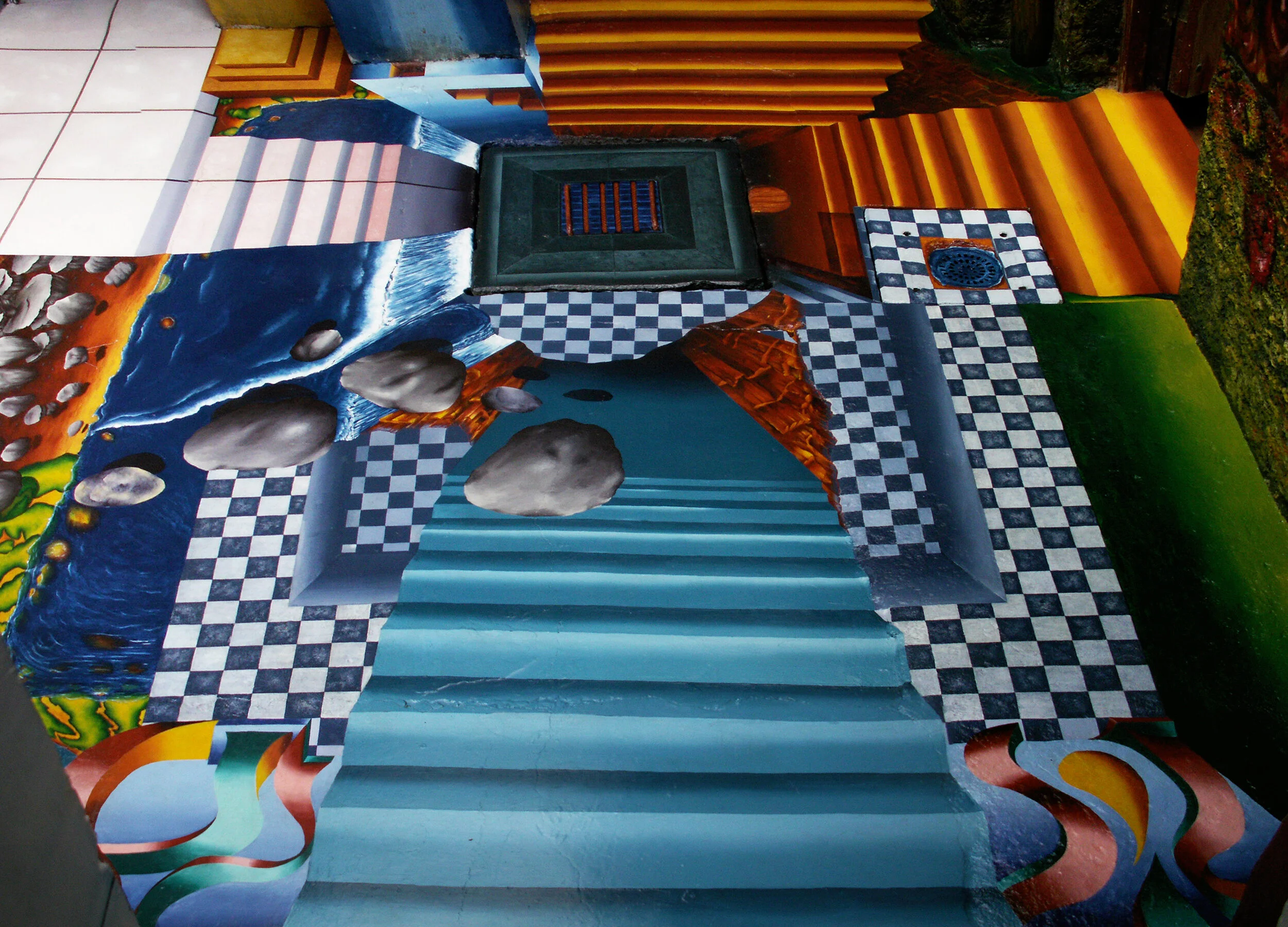
This piece of Art Work originally was painted on Concrete 19’7” X 19’7” on the floor outside a bar. The premise was for the viewers to step on it and not be sure of their footing.
Later on this Art Work was painted with acrylics on canvas 6’ X 6” and is in a collection in Texas.
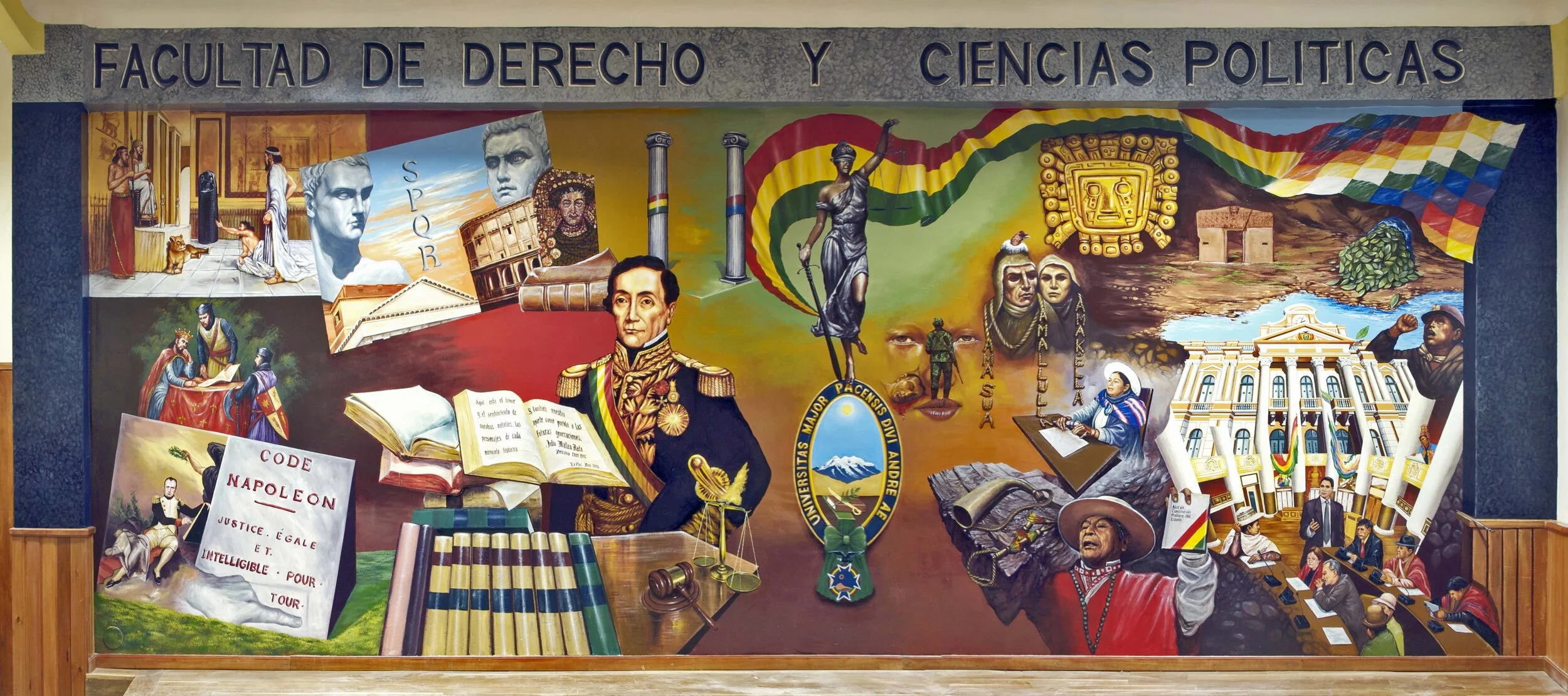
Descolonización de la Justicia Boliviana
La Paz, Bolivia – Main Auditorium, U.M.S.A. / 9’2” x 27’3” / Acrylic and Oil on Cement / 2010
This monumental mural, stretching across the heart of the Universidad Mayor de San Andrés in La Paz, offers a compelling visual meditation on Bolivia’s ongoing struggle to reconcile two legal legacies: the imposed structures of Western law and the ancestral frameworks of Indigenous justice.
Painted in luminous layers of acrylic and oil on cement, the mural stages a dramatic interplay between systems rooted in vastly different worldviews. On one side, Western legal tradition is depicted through iconic historical references—stone tablets recalling the ancient Code of Hammurabi, the scales and statutes of Roman law, and the formal rigidity of the Napoleonic Code, which profoundly shaped much of Latin America’s contemporary legal framework. These legal systems, codified, centralized, and hierarchical, are shown towering above individuals, evoking control from above.
In stark contrast, the Indigenous legal worldview unfolds organically across the composition. Here, justice is not written in stone or administered from lofty courts, but lived daily through customary practice, oral tradition, community assemblies, and spiritual stewardship of the land. Elders, mountains, animals, and sacred symbols radiate from the earth, suggesting a legal system rooted in reciprocity, balance, and the wisdom of generations. It is a justice felt in the body, the soil, the stars.
At the center of the mural, these two traditions clash, overlap, and attempt to coexist. A symbolic "marriage" is portrayed—not one of seamless union, but of tension and contradiction. Tangled threads, broken chains, and overlapping scripts depict the layered complexity of a nation still healing from colonial imposition. Yet within this friction, the mural also holds space for hope—a reimagining of justice that honors Indigenous sovereignty while exposing the inherited inequities of the Western model.
The work invites reflection not only on Bolivian identity, but on the universal question of how justice is defined, by whom, and in whose language. In a country where Indigenous people make up the majority, but have long been marginalized by imported legal doctrines, this mural becomes a vibrant call to decolonize law—at the level of policy, but also in spirit and practice.
In a single sweeping composition, Descolonización de la Justicia Boliviana offers both a mirror and a vision: a reminder of the past’s heavy hand, and a glimpse into a more just, rooted future.
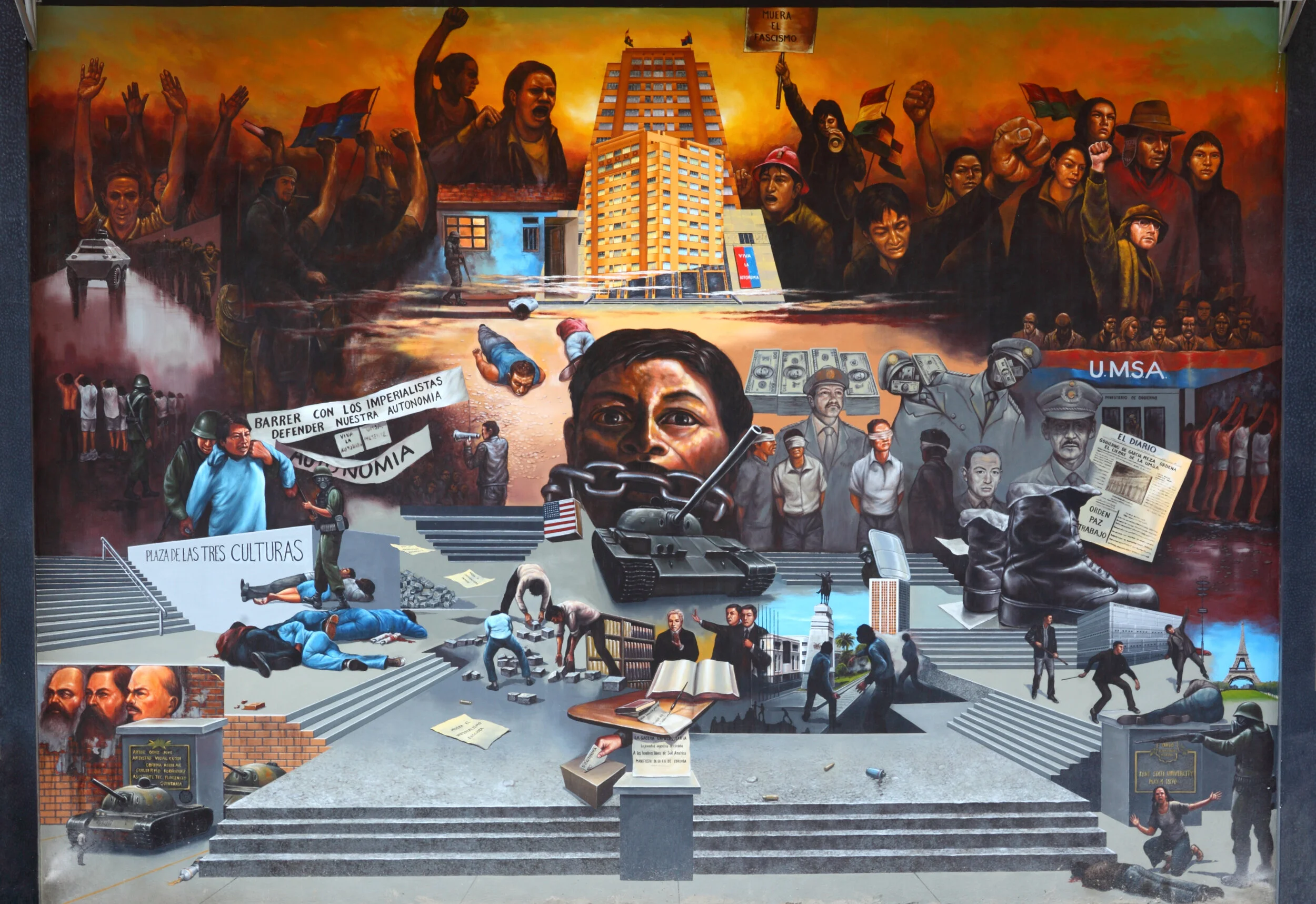
En Homenaje a los Mártires de la Autonomía Universitaria
La Paz, Bolivia | Universidad Mayor de San Andrés (UMSA), Main Patio
6m x 9m (19.68 ft x 29.53 ft) | Acrylic & Oil on Cement | 2011
This large-scale mural, located in the main courtyard of the historic Universidad Mayor de San Andrés in La Paz, Bolivia, pays tribute to the countless students who gave their lives in the fight for university autonomy and democratic freedom. Created in 2011, the work stands as both a memorial and a political statement—recalling the wave of student uprisings that erupted across the globe in the late 1960s and tracing their reverberations into Bolivian society throughout the 1970s and 1980s.
The mural reflects a turbulent era marked by political repression, military coups, and authoritarian rule, during which universities became critical centers of resistance. Bolivian students, inspired by global movements for justice and liberation, faced brutal crackdowns for demanding autonomy, free expression, and democratic governance.
Rendered in vivid acrylic and oil on cement, the composition features powerful imagery of defiant youth, books turned into shields, and broken chains—symbols of resistance, intellectual courage, and sacrifice. The mural not only honors those martyred in the struggle for educational and political freedom but also reaffirms the role of students as catalysts for change. It remains a living reminder of the price of liberty and the enduring fight against oppression.
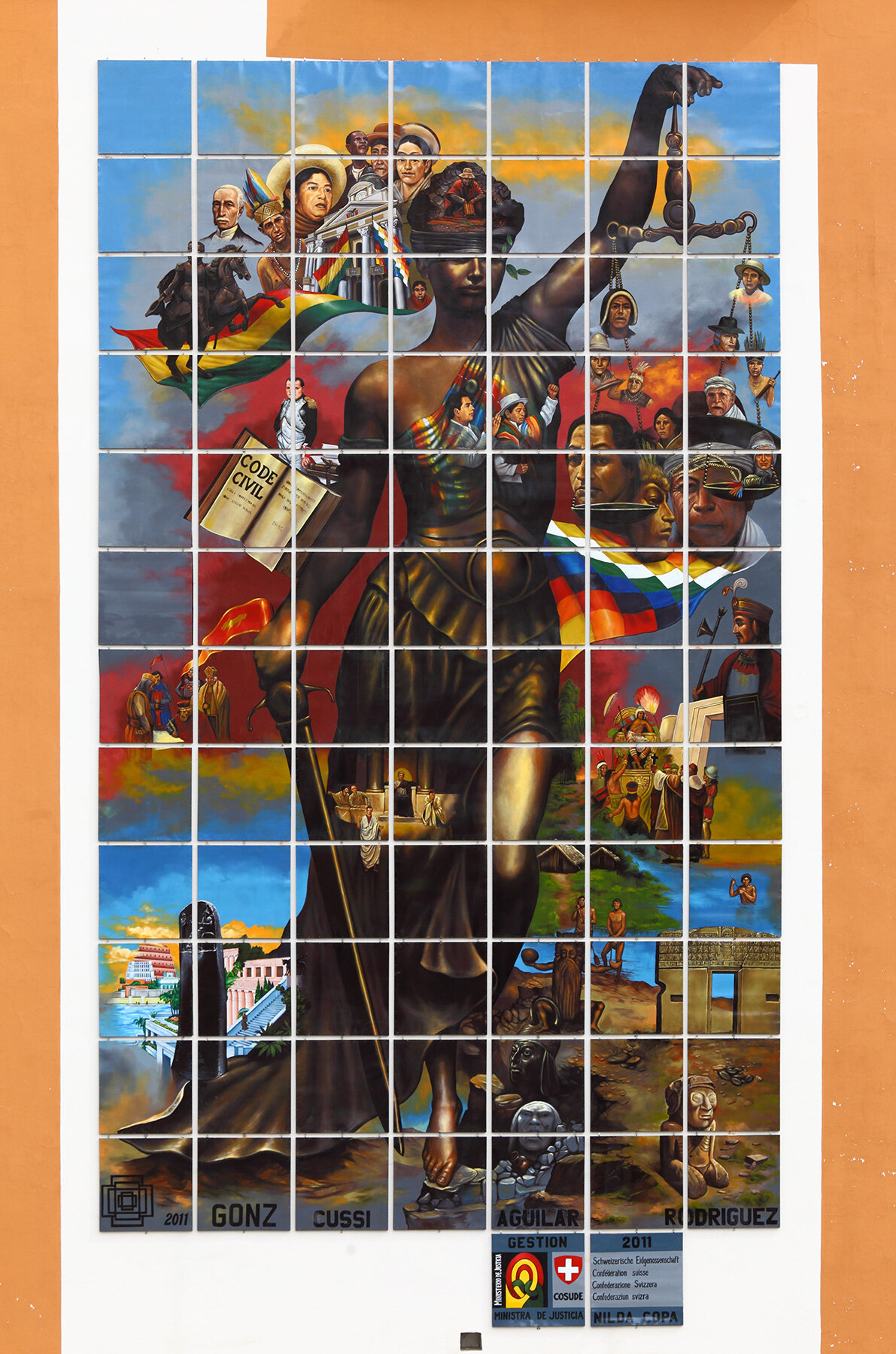
Descolonización de la Justicia Boliviana
La Paz, Bolivia – 12m x 7m (39.37ft x 22.96ft) | Medium: Acrylic and oil on stainless steel | 2012
Painted on the walls of a public legal institution Ministerio De Justicia in La Paz, this large-scale mural grapples with one of the most profound transformations in contemporary Bolivian society: the decolonization of its judicial system. The work visually narrates the ongoing tension—and emerging reconciliation—between two systems of justice that have long existed in parallel: the Western, colonial legal tradition imposed by European powers, and the Indigenous legal frameworks rooted in centuries of communal knowledge, spiritual accountability, and restorative practices.
At the heart of the composition is a symbolic representation of the “marriage” between these two worlds. The mural neither idealizes nor condemns either system, but rather confronts the contradictions, frictions, and urgent need for balance. Figures of Indigenous leaders and legal scholars are placed alongside judges in robes, while scales of justice hover in unstable symmetry. Woven into the imagery are elements of Andean cosmology, sacred geometry, and historical memory—reminding viewers that law is never neutral, but shaped by culture, power, and resistance.
Commissioned in 2012 during a period of major constitutional reform, this piece reflects a pivotal moment in Bolivia’s struggle to reclaim its sovereignty—not just politically, but legally and culturally. The stainless-steel surface acts as a metaphor for both rigidity and reflection: a surface where modernity and ancestral wisdom collide and potentially coalesce.
More than a mural, Descolonización de la Justicia Boliviana is a public declaration that justice in Bolivia must evolve beyond colonial legacies and toward a future that respects and integrates Indigenous systems of governance, values, and voice.
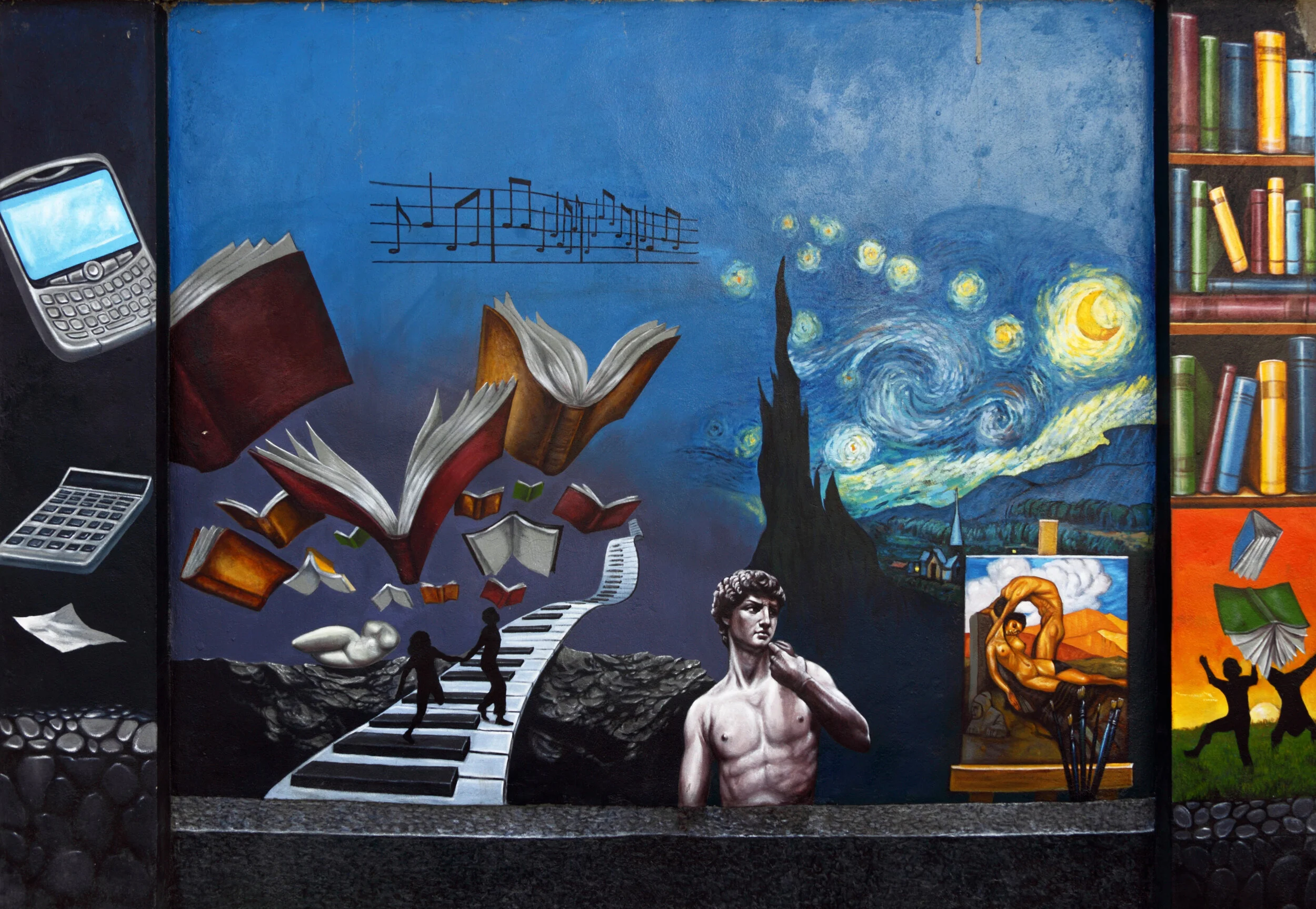
Mural / Mural Hugo Davila - Educación Necesaria La Paz, Bolivia / 10ft X 59ft / Medium: Oil on cement / 2011. This mural was painted at the entrance of this High School, each subject matter that was required to graduate was represented in this mural.
This particular section was one that had to do with the Arts
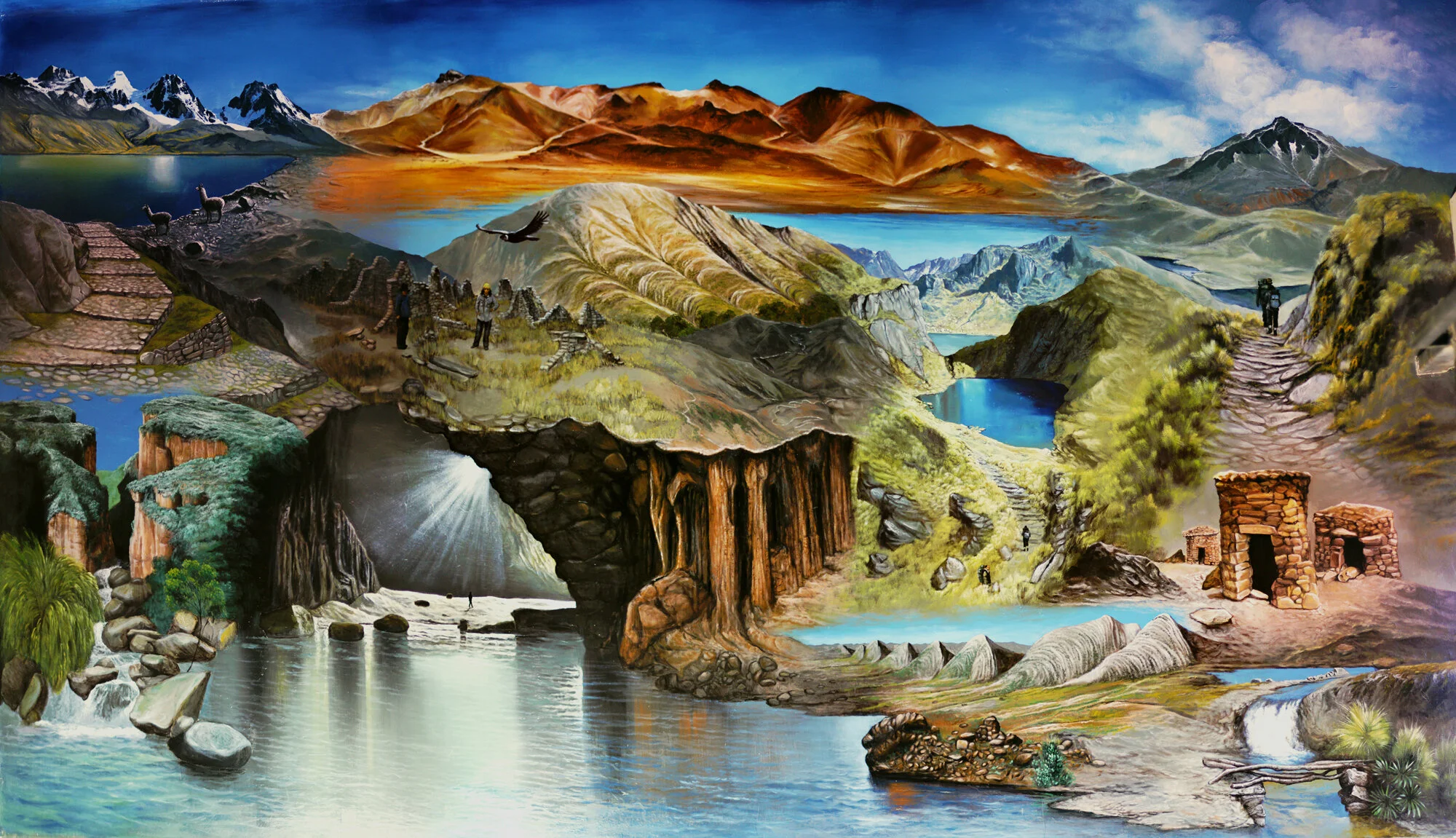
Trekking Bolivia La Paz, Bolivia - 2.5 x 8 mts (8.20ft X 26.25ft) - Medium: Oil and plaster - 2012 This is a set of Murals dedicated to touristic places around the world. Trekking Bolivia is a section dedicated to places where my brothers and I did some trekking on some old Inca roads and visited Iscanhuaya Ruins on a four day journey.
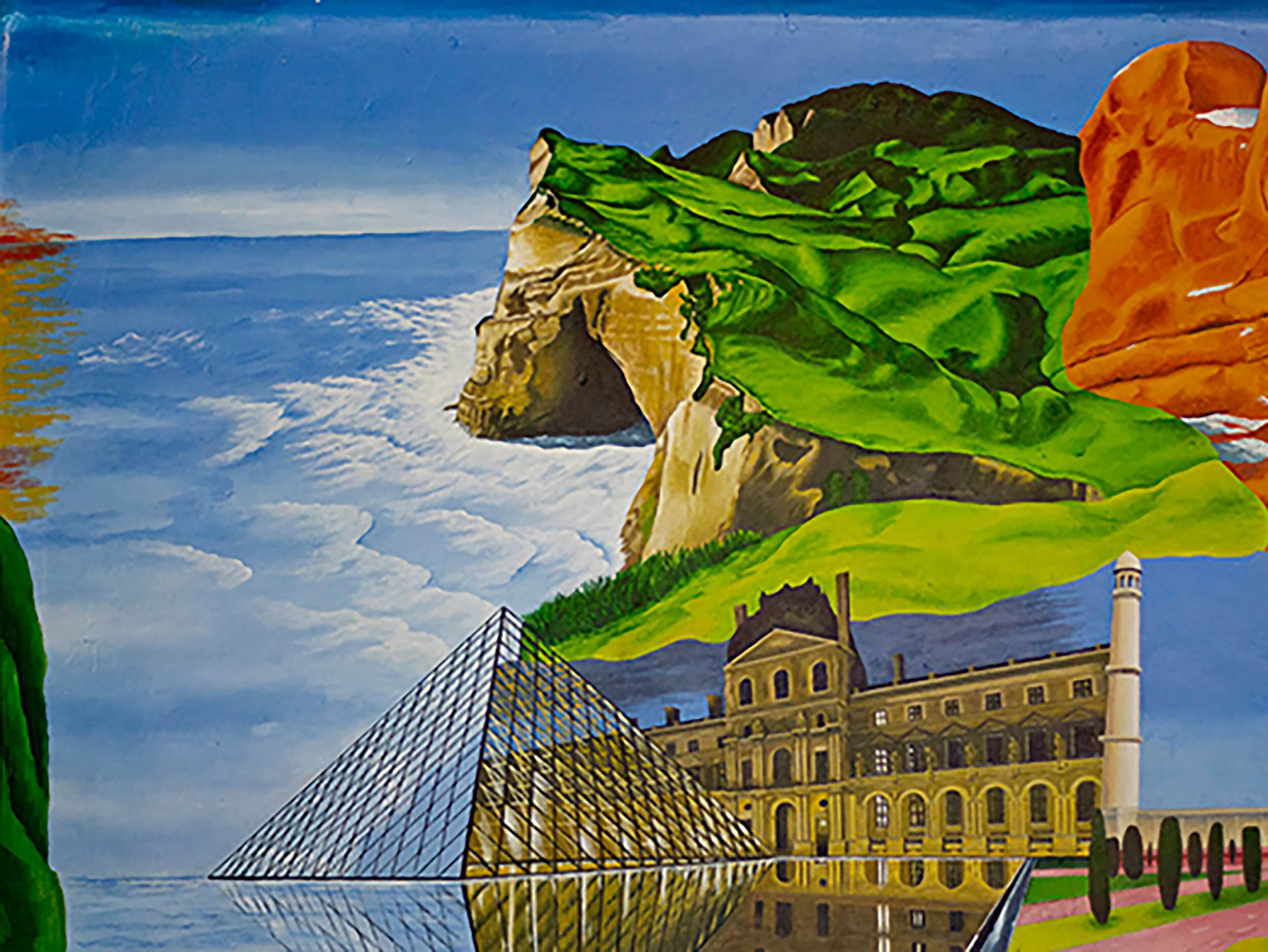
Mural / Classic Murals La Paz, Bolivia / 19’-7” X 5’ - Medium: Acrylic on plaster / 2012. These are classic tourist places to visit around the world. These murals were painted for a travel Agency in LaPaz Bolivia.
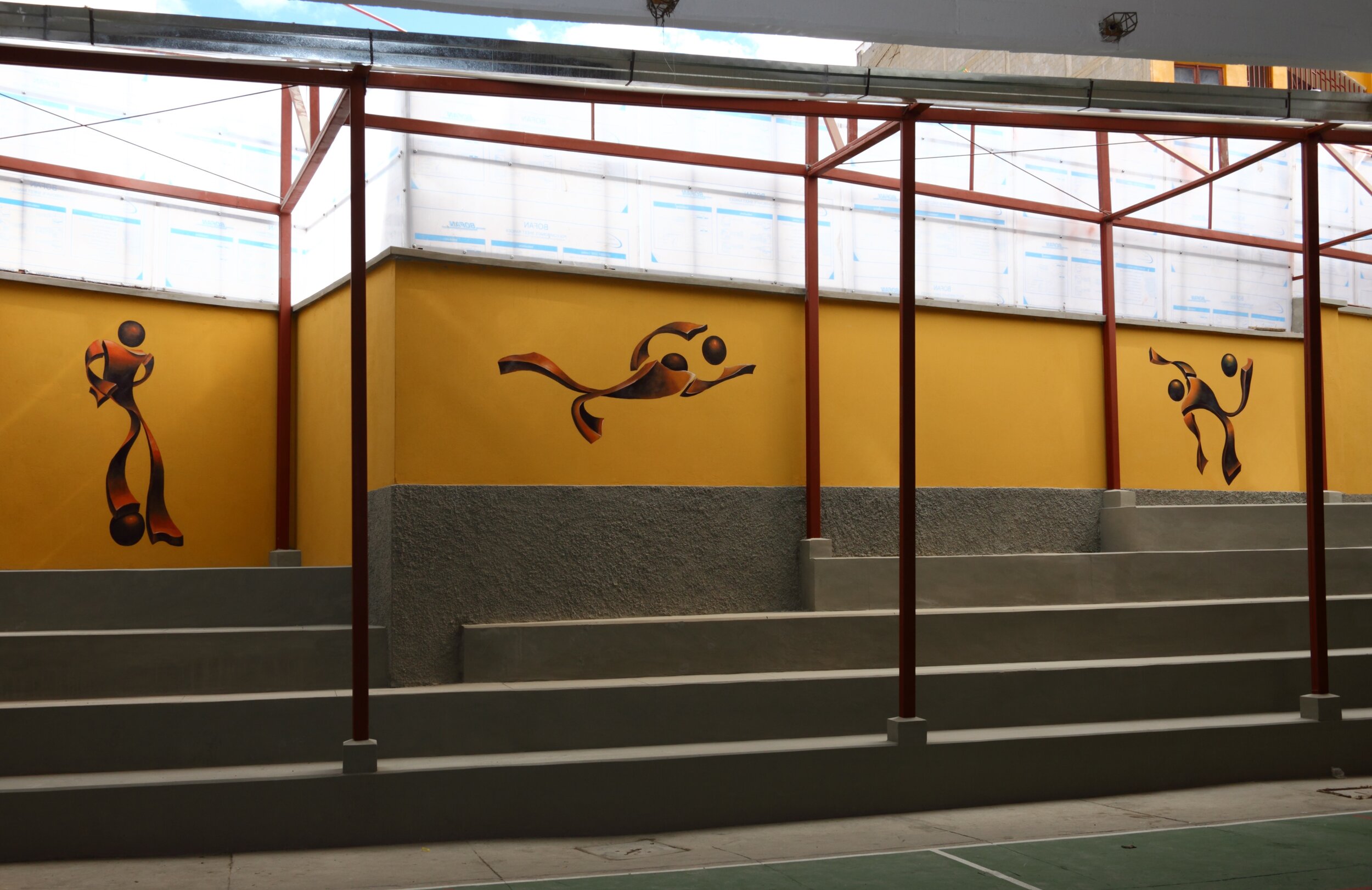
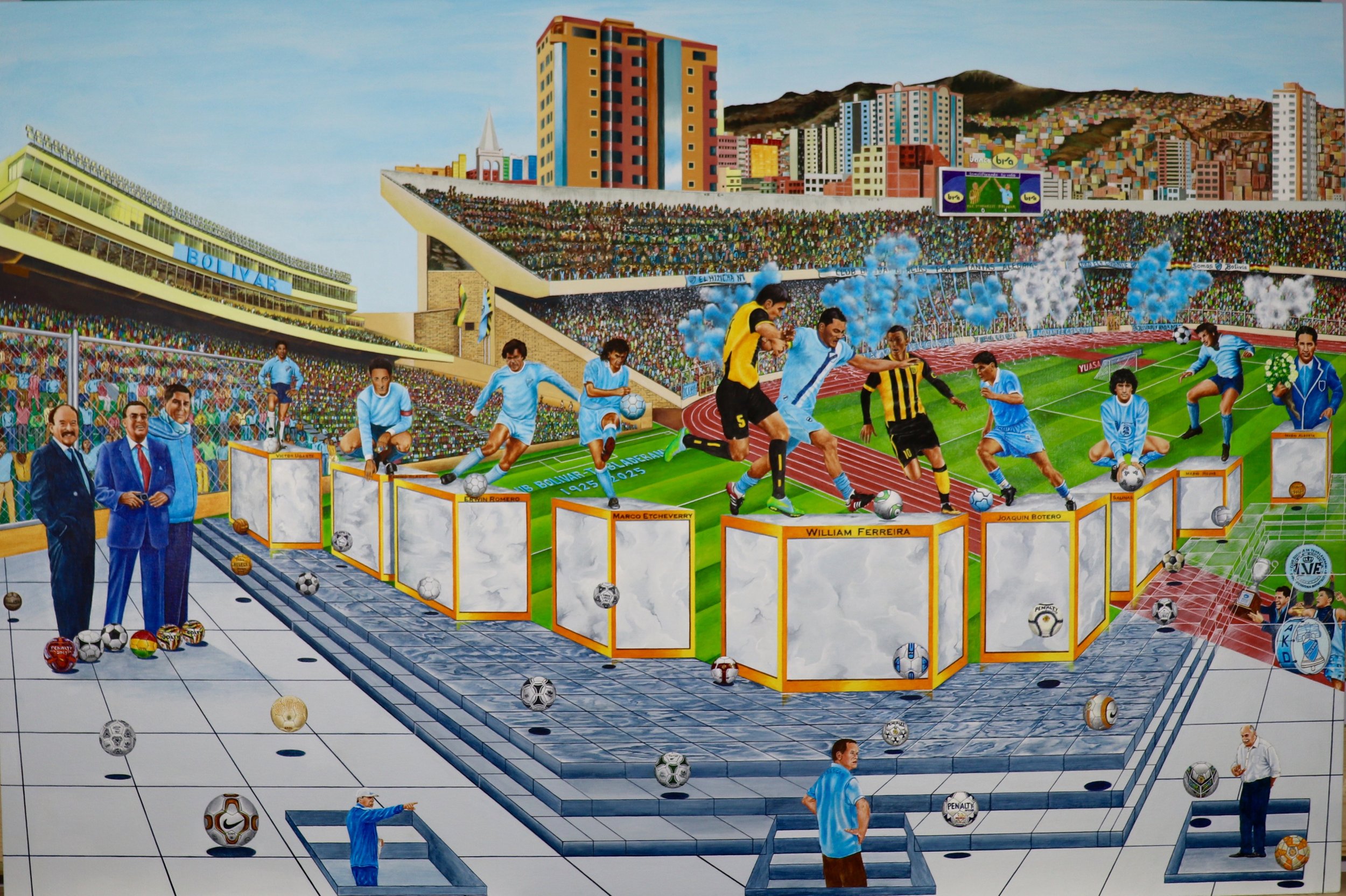
These soccer players were developed from my love of pillars and my love of soccer. These players were painted in a gym at UMSA University in LaPaz Bolivia
This mural begins where humanity itself began—on the African continent. It presents Africa not through the lens of colonization or suffering, but in its full glory, as the birthplace of civilization, culture, and knowledge. Through vibrant imagery, it honors the prehistoric origins of humankind, the flourishing of agriculture and science along the Nile Valley, and the rise of great empires such as Mali, Ghana, Songhai, Nubia, and Ethiopia. These civilizations built universities, libraries, trade networks, and artistic legacies that shaped the world long before European contact.
This section challenges Western narratives that often erase or diminish Africa’s vast contributions. It’s a reclamation—a visual restoration of pride, identity, and truth. The strength and richness of these pre-colonial societies serve as the moral and historical foundation for what follows in the mural. It reminds us that African history did not begin with slavery—it began with greatness.
“I created a visual timeline beginning with the dawn of humanity to the rise of human civilization, through periods of resistance, oppression, and celebration. The story ends with depictions of great people who helped shape the world we live in today.”
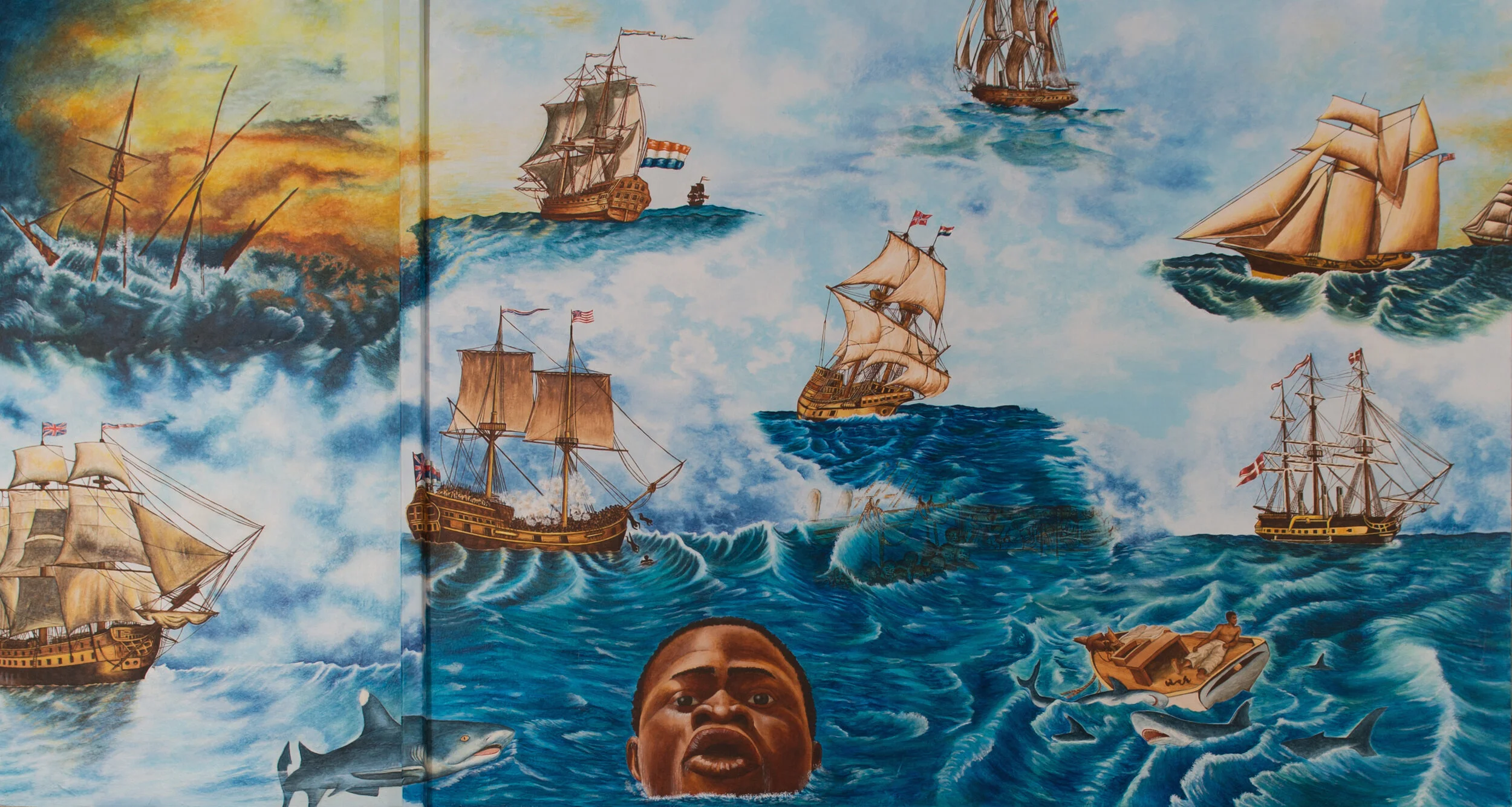
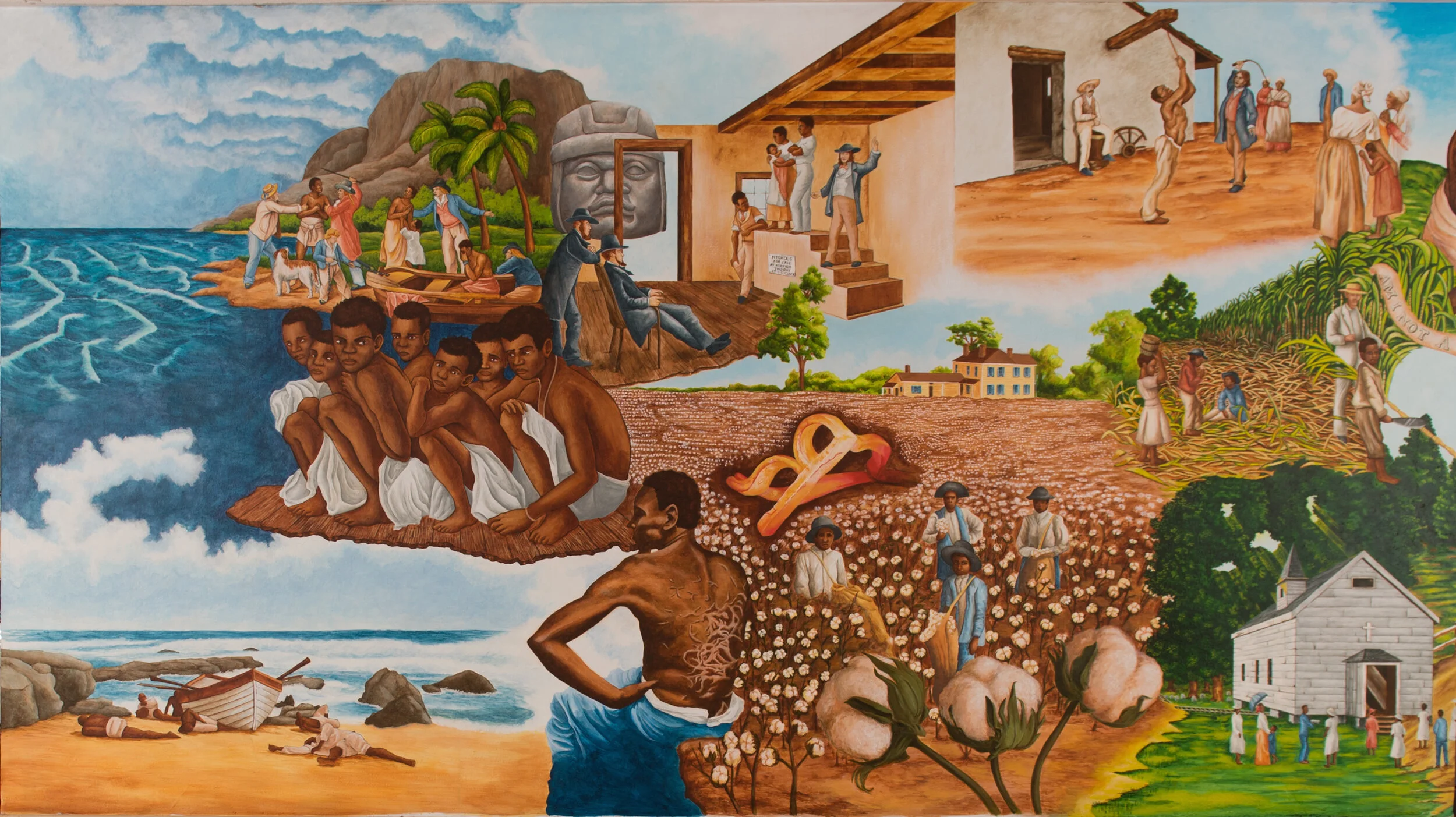
This section bears witness to one of the most harrowing chapters in human history: the transatlantic slave trade. It depicts the violent rupture from homeland to forced displacement, focusing on the Middle Passage—the horrific sea journey endured by millions of captured Africans. Cramped, shackled, and dehumanized aboard slave ships, an estimated one-third perished before even reaching shore.
The mural does not look away. It shows the trauma, the loss, the tears—but also the defiant spirit carried across oceans. Cultural memory, songs, beliefs, and languages survived alongside the human cargo. This section is not just about what was taken, but what was preserved under impossible circumstances. It reflects the beginning of a diasporic identity forged in suffering and survival.
It is a call to remember the cost of empire and a testament to the ancestral strength that still echoes through the descendants of those who endured it.
There, the story shifts from survival to resistance—from enduring oppression to actively reshaping the world. This final section traces the legacies of slavery, colonialism, and institutional racism through centuries of struggle. It acknowledges the brutality of Jim Crow laws, apartheid, mass incarceration, and cultural erasure—but centers on the defiant beauty of those who fought back.
From revolutionaries and freedom fighters to poets, artists, scholars, and community leaders—this portion of the mural honors those who stood up against injustice and envisioned a better world. It celebrates the Harlem Renaissance, civil rights movements, independence struggles across Africa and the Caribbean, and modern movements for racial and social equity.
Bold colors, dynamic forms, and ancestral symbolism declare a message of dignity, hope, and power. The mural ends not in mourning, but in triumph—with portraits of changemakers who continue to influence global consciousness. It’s a reminder that resistance is also an act of creation.
“This is not just a mural. It’s a living archive of the African experience—a story of humanity, of loss and legacy, of struggle and celebration. It asks us not just to look, but to remember.”
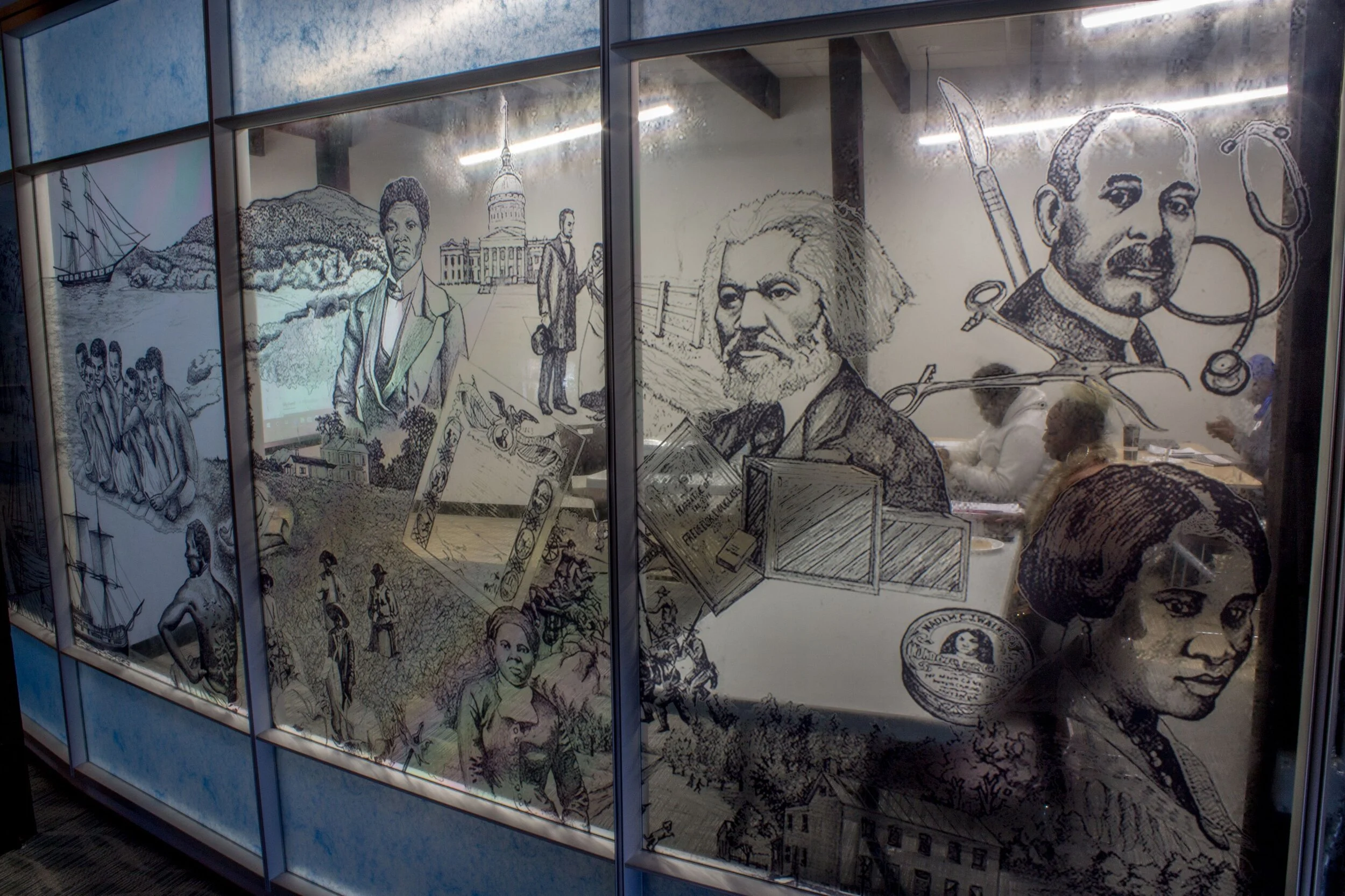
These images were from the original drawings for the mural Arts and Empowerment . They got transferred onto the glass.
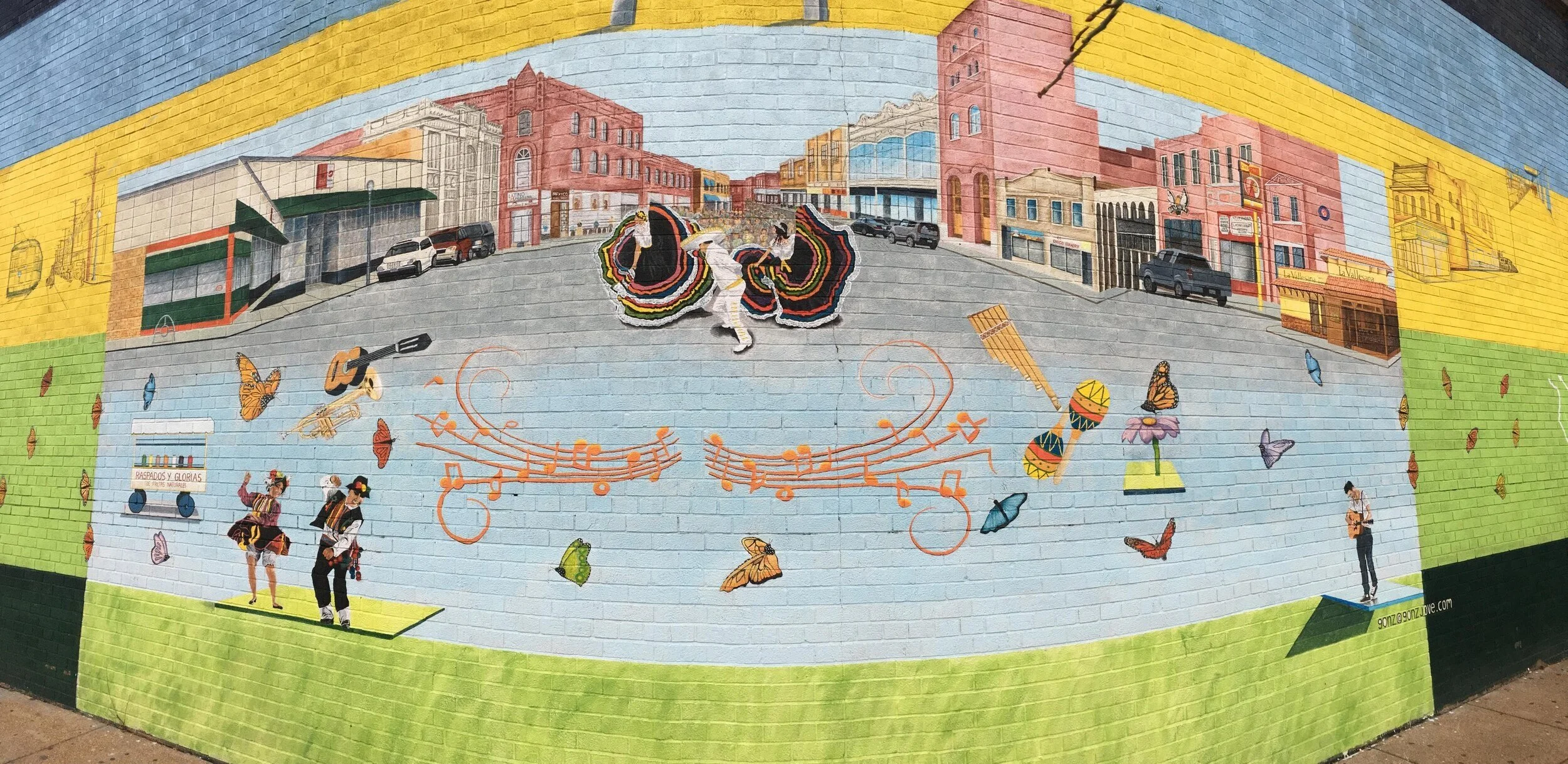
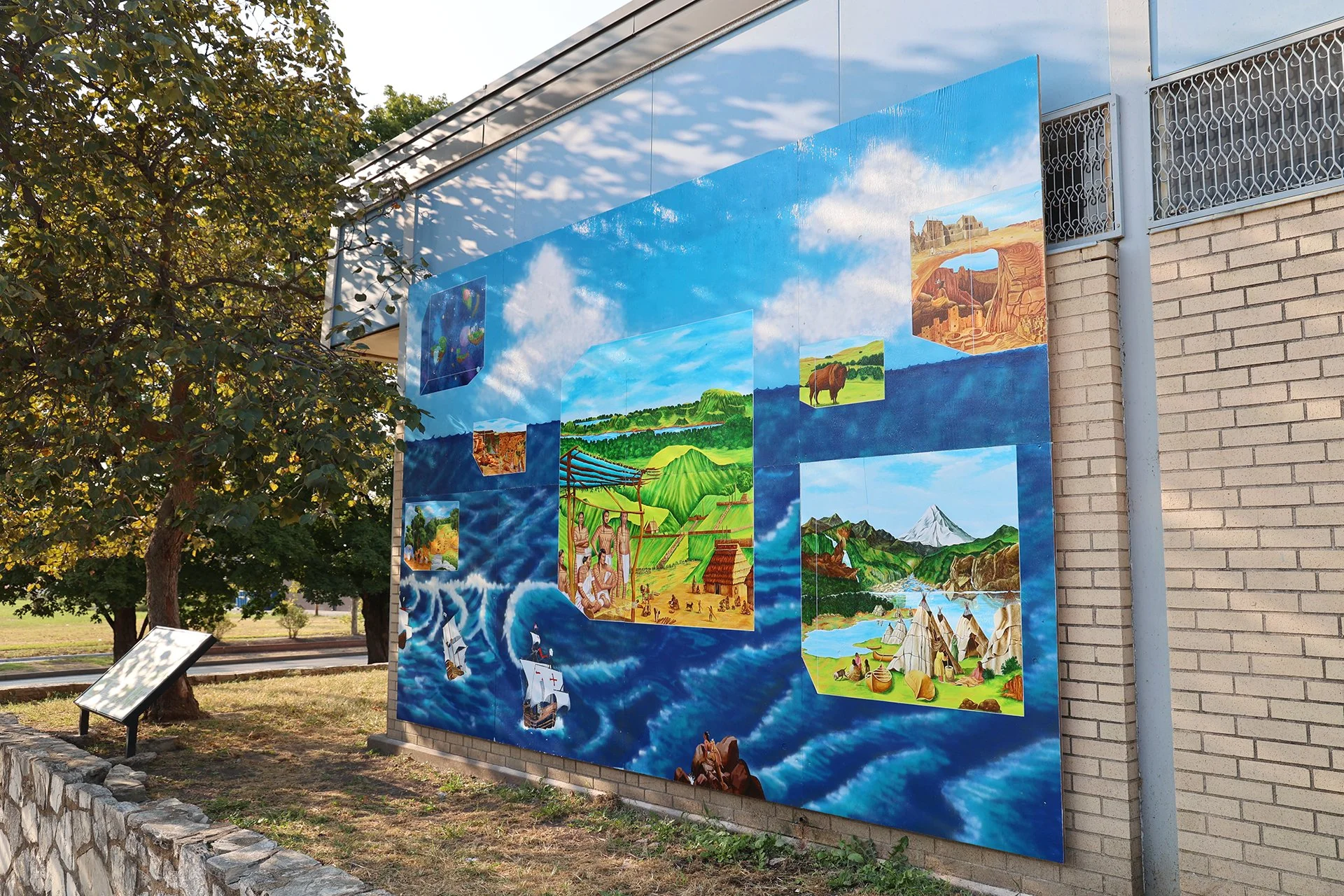
Cherokee Street is named after the Cherokee Tribe of Indians who were considered the most educated and civil. The Cherokee Indian is the symbol of honesty and fair dealing. That is the tradition that runs deep on this street which has a rich legacy of architectural variety and loyalty from residents nearby and now a thriving Latinx Community.
The Cherokee Street Development League commissioned me to paint a mural , which has recently received a historic marker sign for Calle Cherokee, recognizing the important cultural and economic contribution of Mexican Americans to the revitalization of the commercial corridor called Cherokee Street.
The mural shows the historical timeline of Cherokee Street and portions of the mural play homage to the streetcar and other historical landmarks.
Finally, the migration of the Monarch Butterfly is shown in a map of the Americas as a symbol of how all living things on earth do not have geographical boundaries that mother earth is for all living beings including us human beings.
This mural was created to commemorate the Annika Rodriguez Scholars Program, a scholarship program dedicated to the values of diversity, community service, academic excellence, and leadership. When designing the mural, we intentionally invoked the style of Chicanx street art to pay homage to the Latinx roots of the program and create a distinctly unique piece of campus art. While the mural was initially conceived to honor the program, it is ultimately a piece made to celebrate diversity and activism in all forms at WashU and in St. Louis.
This mural as my other murals, means becoming engrossed in the narratives, channeling the emotions of the community and moment in history the mural represents. When you do this right and with intention, the work begins to speak through your soul. You can translate the anger of injustice into the strokes of your brush and portray the color of liberation movements on a wall.
This quick 8’ X 12’ mural was done to celebrate Black History Month 2020 at Better Family Life. This mural was to summarize the Harlem Renaissance, a rebirth of African American culture through art,music, poetry, and theatre. During the Great Migration of rural African Americans to urban areas such as New York City, Black culture grew as artists and musicians found a place for their creativity to flourish in communities like Harlem. Harlem was trendy and hip during the roaring 20s, the highlight of Harlem Renaissance, and white audiences flocked to Harlem to be entertained in venues like the Cotton Club and the Apollo Theater. The main reason art and music in Harlem boomed so tremendously was not because prior to the Harlem Renaissance art did not exist, but rather because it had not been popularized and sponsored.
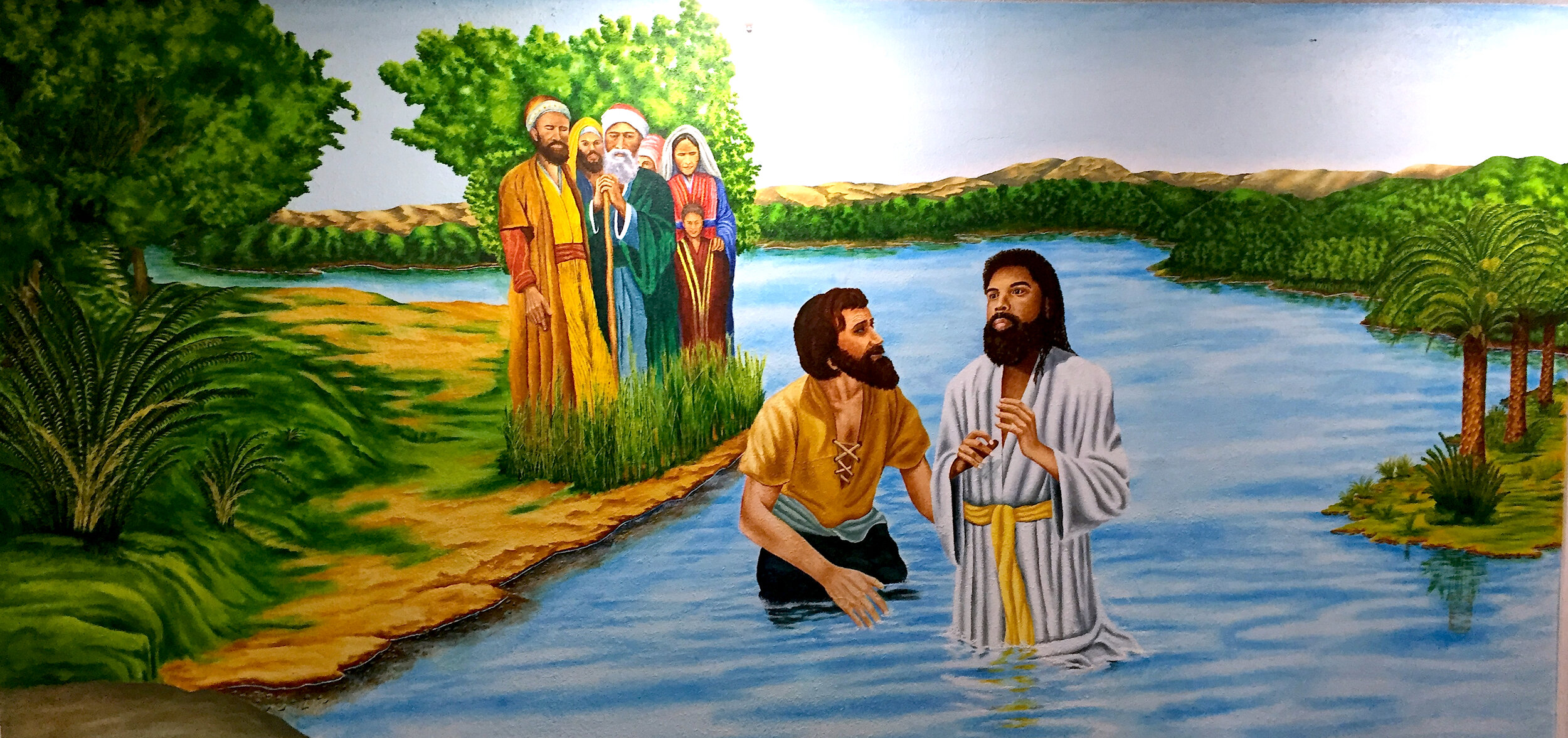
This mural which measures 6’H X 12”W painted with Liquitex Acrylic paints on plaster. This mural is located in Christ Is The Rock Missionary Baptist Church in East St Louis. This was a very interesting commission as my patrons wanted a more realistic view of Jesus, as a man of color, since the geographical area where he comes from is in the Middle East . I tried to portray him as a man of the earth humble but loving.
This mural will be painted in La Paz, Bolivia sometime in the near future in the new stadium that is being built in commemoration of its 100 anniversary. Painting this mural is a dream come true as I have been following Bolivar since my infancy and it occupies a good portion of my heart.
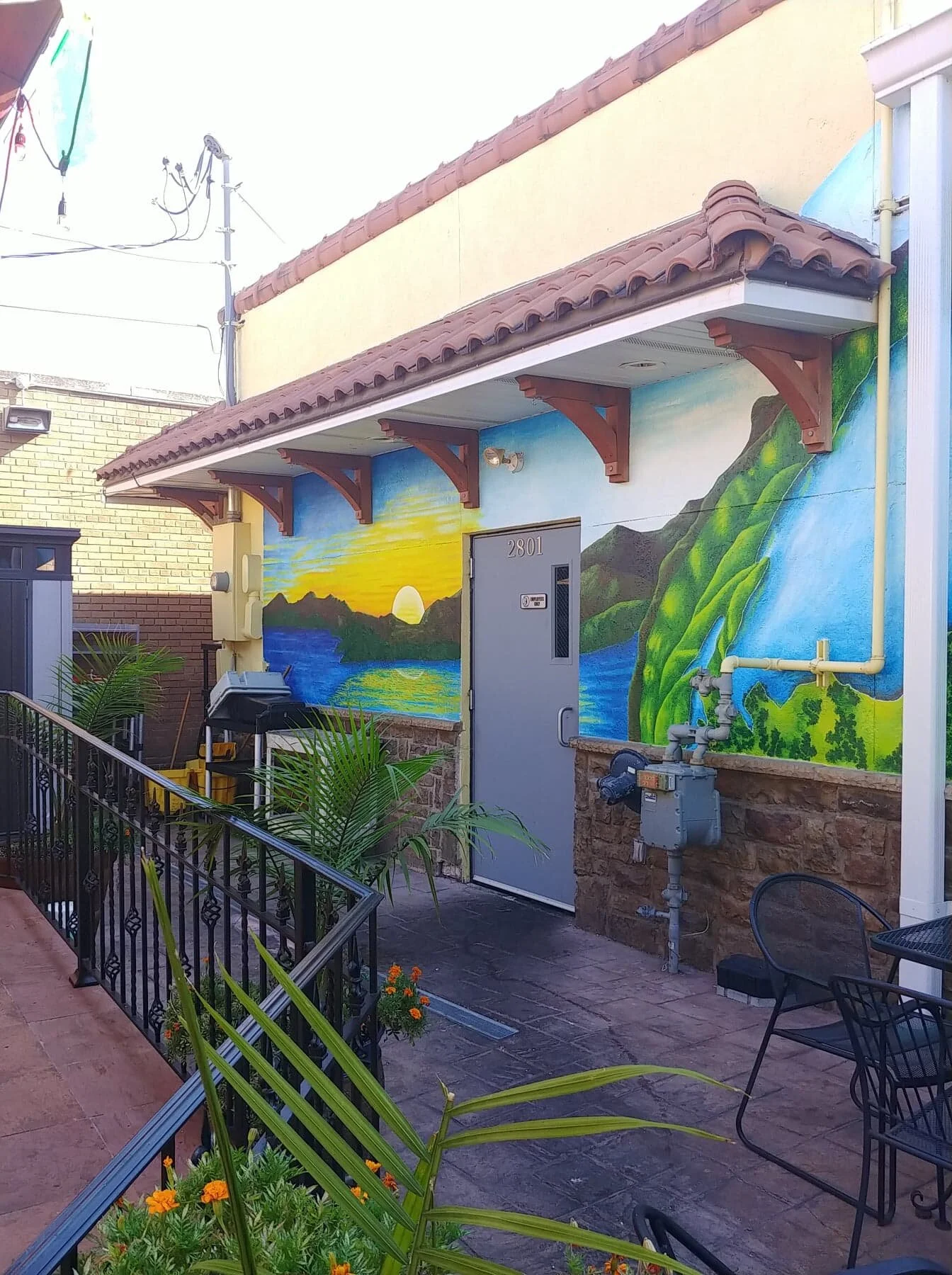
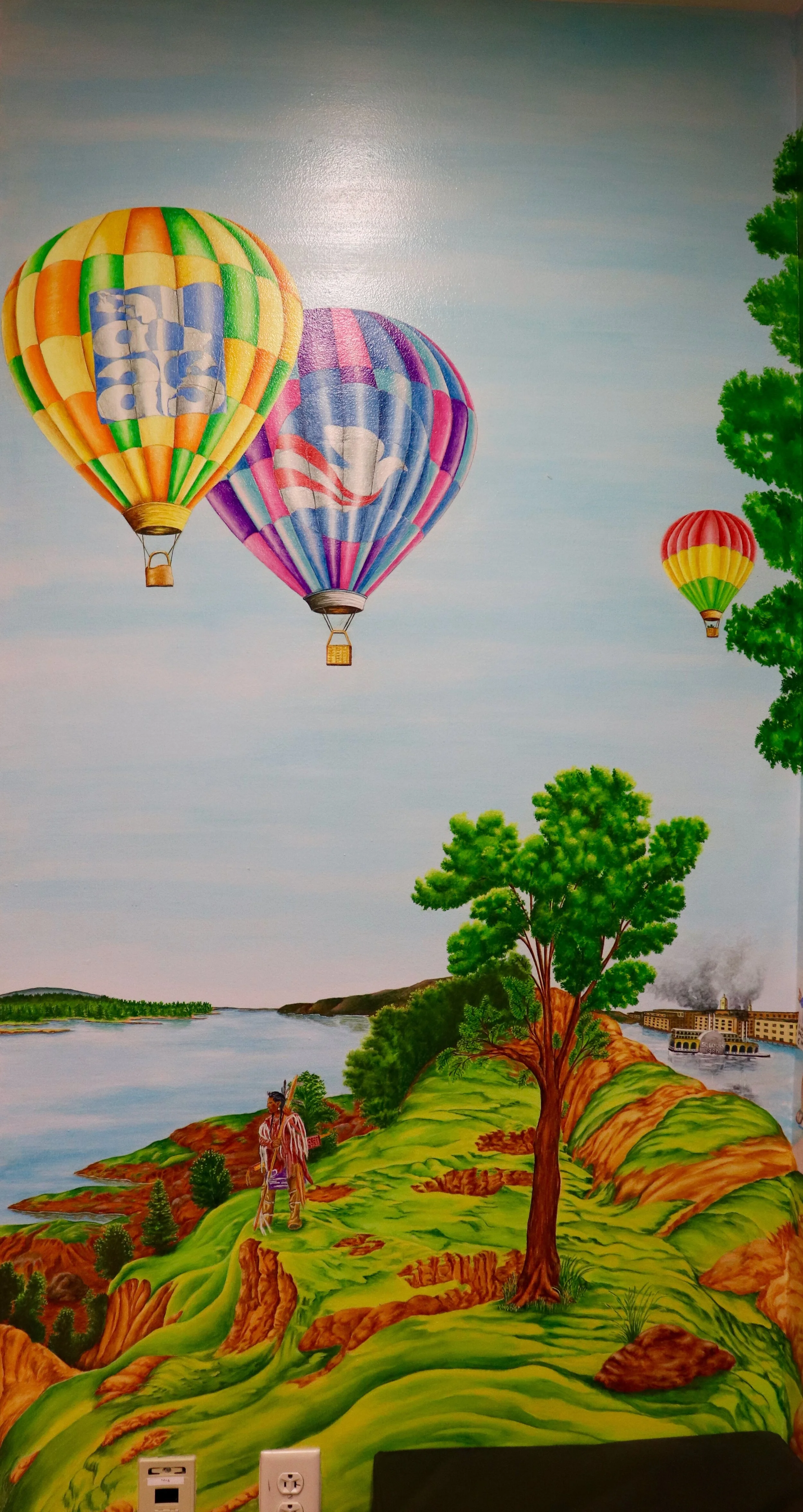
This mural is being displayed in Laura’s Back Porch. Flint Hills is a special place for Laura because it is where she passed a good portion of her childhood. The rolling hills and the vastness of the space was my inspiration for this mural
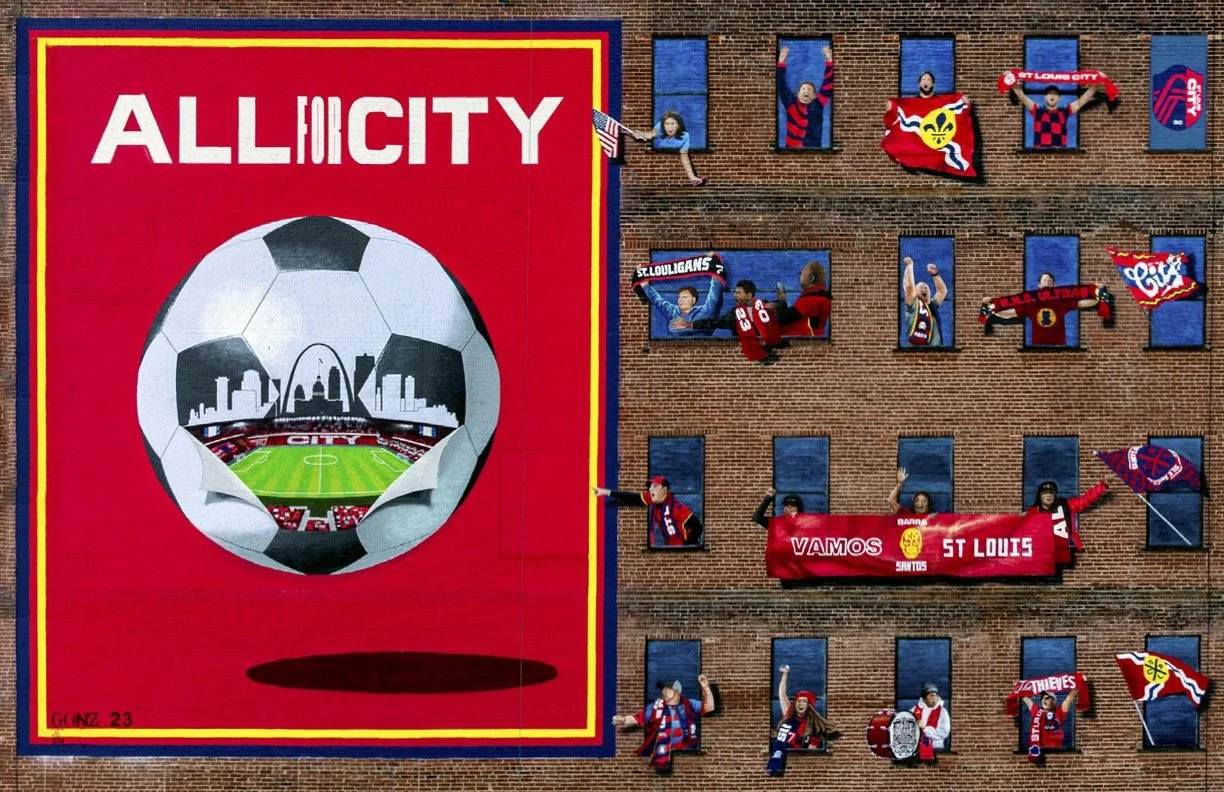
All For City Mural
“All for CITY” – “A powerful symbol of unity, fostering a sense of pride and connection among fans who saw their stories reflected on the walls of their beloved STL.” The mural is located at 308 N. 21st Street, (building is also home to the St. Louis Sports Commission), across from CITY PARK at Olive Street
“This project began in late October through a partnership with the building’s owner to celebrate St. Louis CITY SC’s incredible inaugural year and the tremendous support and passion of St. Louis’ soccer community, including our recognized supporter groups. We hope that when people drive up Olive Street toward CITY PARK, soccer fan or not, they feel a sense of pride and optimism in this spirit of a new St. Louis.
This mural stands as a tangible manifestation of a soccer city deeply rooted in the sport's rich history. I sought to convey the profound passion that St. Louisans harbor for soccer. The deliberate choice to maintain the traditional black and white design of the ball is a deliberate nod to history, a visual thread connecting the mural to the sport's enduring legacy.This mural, therefore, becomes more than a mere visual spectacle; it emerges as a living testament to the shared stories and fervor of acommunity deeply entrenched in the world of soccer.
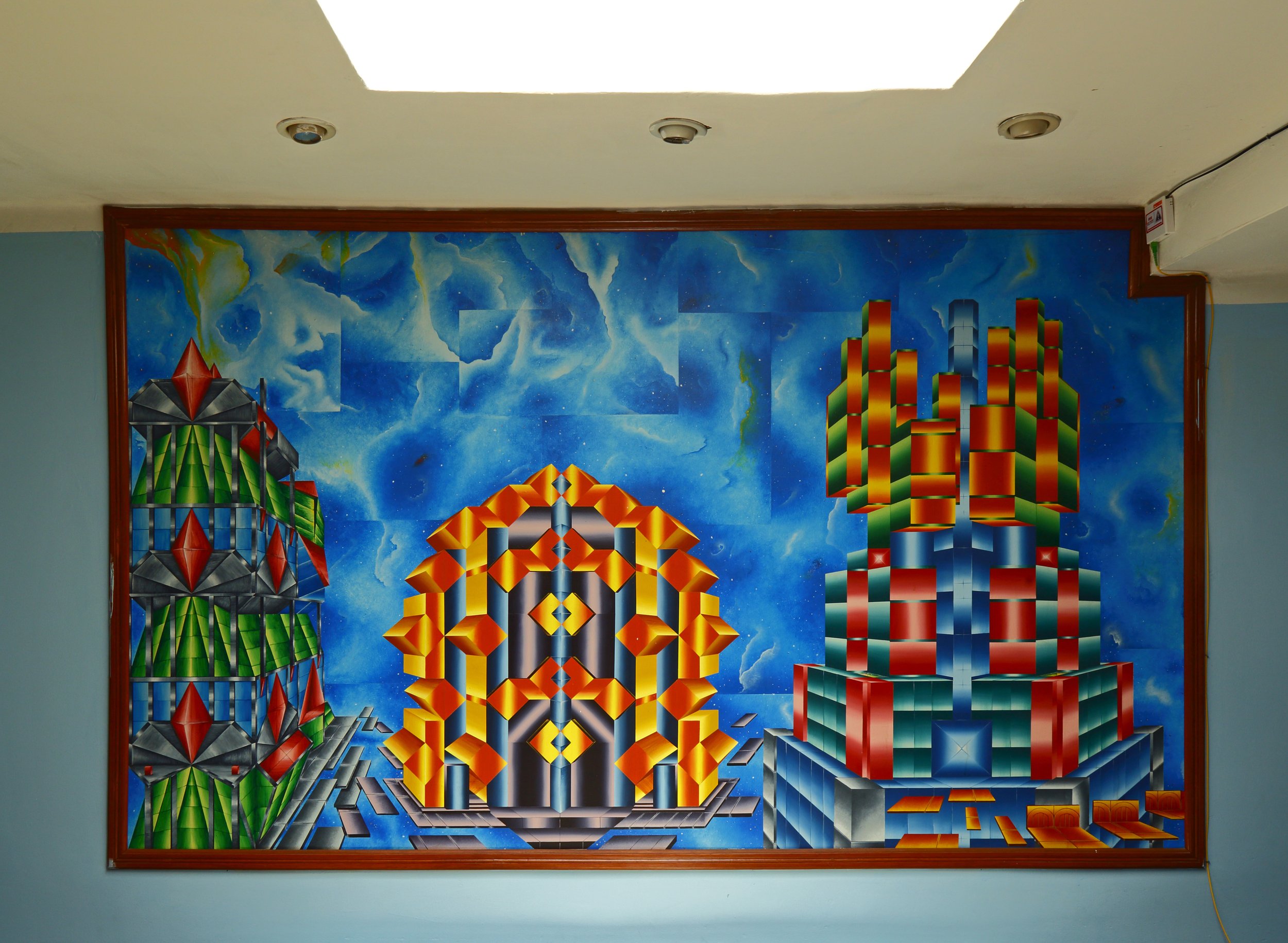
This mural is an equation with multiple variables, resulting in subtle spaces that are visually pleasing. Exploring spaces through mathematics is immensely enjoyable. Perspective serves as my gateway to the stars, fascinating me with its ability to manipulate lines and space. It's remarkable how this tool can bend perception and create intriguing compositions. Perspective is ubiquitous; we need only to seek it out and appreciate the beauty it brings to our surroundings.